Start with the thing that is easy to say and hard to feel: roughly two billion years ago, an asteroid several kilometres across struck what is now the Free State. It is the oldest and largest verified impact structure on the planet. The original crater was on the order of three hundred kilometres wide. Everything we do — every patrol, every count, every school group — happens inside it.
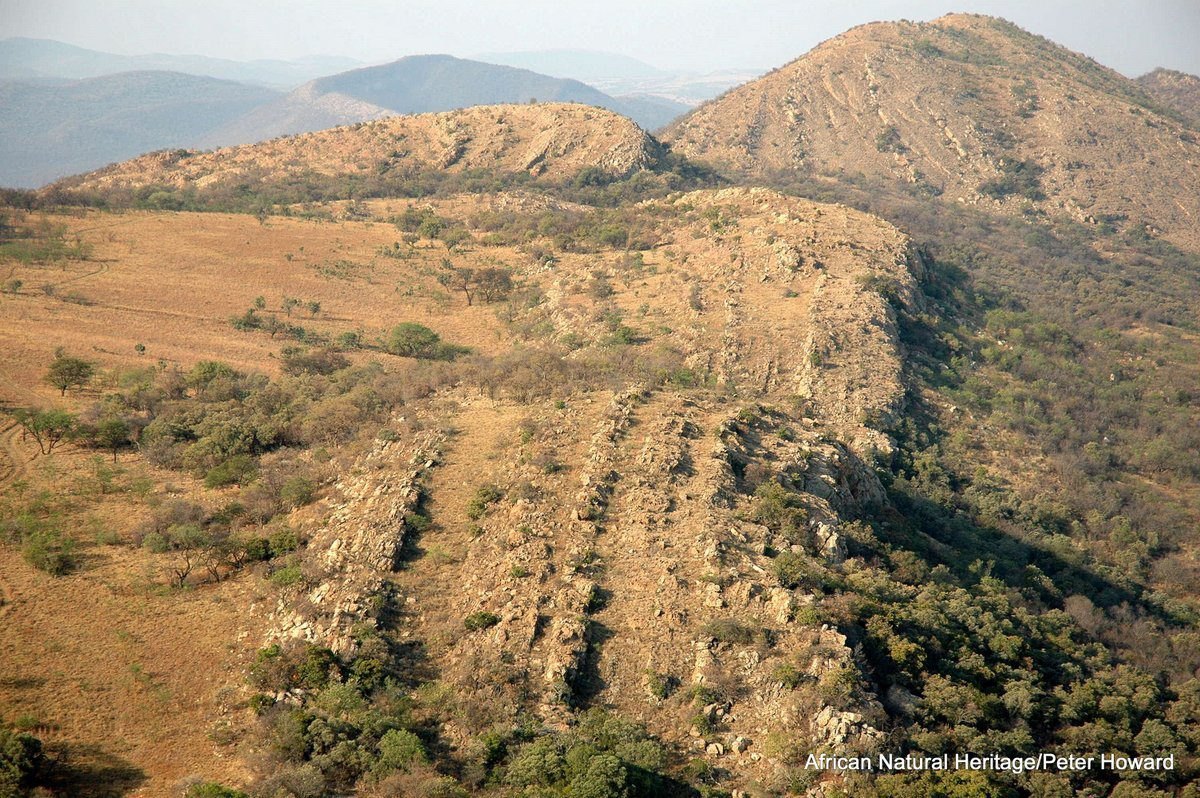
Two billion years is long enough that the crater itself is gone. What is left is its root. Erosion has stripped away kilometres of rock from the top, and what you drive through today is the deep floor of the structure, turned inside out. The hills that curve around Parys in that unmistakable arc are the collar: layers of sedimentary rock that were standing flat before the impact and were flipped past vertical by it. In places the beds are overturned. The younger rock lies beneath the older, which is not how the world is supposed to work.
The centre is granite — Archean basement, some of the oldest rock exposed anywhere in southern Africa, brought up from far below by the rebound of the crust after the strike. It is worth sitting with that for a moment. The rock under your boots was several kilometres underground until something hit hard enough to lift it.
The evidence that this was an impact and not a volcano or a fold in the crust is written at the scale of a hand specimen. Shatter cones — striated, cone-shaped fracture patterns that radiate through the rock — form only under the shock pressures of a hypervelocity impact. The dome is one of the best places in the world to see them. There is also pseudotachylite: rock that was melted by the shock and re-froze in dark veins running through the granite, some of them wide enough to walk along. The quarrymen who worked it for decades knew it as a good black stone. It is a fossil of the instant of impact.
UNESCO inscribed the dome as a World Heritage Site in 2005 on exactly these grounds — not for its scenery, but as the single best surviving record of the largest known impact event in Earth's history.
Why does a wildlife trust write about geology? Because the geology is not background. The arc of the collar hills is what creates the sheltered valleys, the varied aspects, the thin rocky soils and the deep alluvial ones. It routes the water. It decides where grassland gives way to bushveld, where the cliffs are that the raptors nest on, where a snare-line can be walked and where it cannot. The reason this pocket of the highveld holds the diversity it holds is that something hit it two billion years ago and left the ground complicated.
Andy will tell you, if you get him started on a slope somewhere, that you cannot really see the dome. It is too big. You can only ever be inside it. The trick is learning to read the pieces — the tilt of a bed, the curve of a ridgeline, the black vein in the granite — until the shape of the whole thing assembles itself in your head.
We protect the living part. But the living part is here because of the rock, and the rock is here because of a very bad morning two billion years ago.